In this story
Imagine a group of paintings, photographs, sculptures, and ceramic pieces in front of you.
If you could choose the ones you liked and decide which should sit next to each other, what would guide your choices?
You might group works with similar colors. You might connect pieces from different countries because they make you feel the same way. Or you might arrange them so that a story unfolds as a visitor moves from one to the next.
In a museum, selecting and arranging artworks to help people explore a theme or story is part of a practice called curating.
RM of BTS has now worked with museum curators to bring artworks from his personal collection into an exhibition. It offers a chance to think about how choosing and connecting can be creative acts, too.
What happened?
RM x SFMOMA: Between You and Me opened to the public at the San Francisco Museum of Modern Art, known as SFMOMA, on October 3, 2026, local time. It runs through February 7, 2027.[1]
The exhibition brings together nearly 180 works from RM’s collection and the museum’s holdings. Nearly 150 come from RM’s personal collection.[1][2]
EXHIBITION AT A GLANCE
- Where
- SFMOMA · San Francisco, United States
- When
- October 3, 2026–February 7, 2027 · local dates
- Works
- Nearly 180 in total; nearly 150 from RM’s collection
- Co-curators
- RM, América Castillo, and Hyoeun Kim
These are artworks RM has collected, presented alongside works owned by SFMOMA. The exhibition is not a display of 180 paintings made by RM.
He co-curated the exhibition with SFMOMA’s América Castillo and Hyoeun Kim. He also wrote wall texts and artwork labels and recorded an audio guide in Korean and English.[2]
Visitors can explore both the artworks and the choices that bring them together: what caught one person’s attention, and how those interests became a shared experience.
Building invisible bridges between artworks
Works by Korean artists, including Yun Hyong-keun, Kim Whanki, Chang Ucchin, and Park Rehyun, appear alongside works by artists from other parts of the world. The exhibition connects them through themes such as nature, memory, and human life.[2]
One pairing brings together Yun Hyong-keun and American artist Donald Judd. Their works use simple forms to create a sense of space. The pairing also reflects a real connection: the two artists knew each other, and Judd supported Yun’s work internationally.[3]
Another pairing places Kang Yobae’s painting of a sleeping cat beside Wayne Thiebaud’s painting of a clown and a tiger. Both feature cats, but the feelings they create are very different.[3]
Placing two artworks together can give a visitor new questions:
“What do these two works have in common?”
“Why can the same color feel so different?”
“Would I have put these pieces together?”
Curating involves finding relationships, choosing what people encounter first, and considering which questions they might take away.
Your taste can begin with what you notice
In a museum, it can be easy to feel that we need to understand a work “correctly.” We may even feel that we should like a painting because its artist is famous.
But wanting to stay in front of a work a little longer is a useful beginning.
A color might catch your eye. A face might make you curious. Or you might find yourself returning to a piece without knowing exactly why.
The exhibition includes a section for works that appeal to RM even though they resist easy classification.[3] At iD News, we see this as an invitation to begin with attention and curiosity, alongside what art history can teach us.
We can then move beyond “I like it.” What part do we like? What memory does it bring back? Does it remind us of another work?
Putting those feelings into words can turn a vague preference into a more specific observation. Our taste can grow as we encounter new things and learn to notice our own responses.
Who helps an exhibition come to life?
An exhibition depends on many people and different kinds of work.
Artists make the works. Other people research them, care for their condition, shape the exhibition’s story, design the space, adjust the lighting, and help visitors understand what they are seeing through writing or audio.
Sharing Korean art with international visitors can also involve translation and explanations of its cultural and historical context.
A child’s interest in this world may show up in ways beyond drawing or painting.
One child might enjoy finding patterns and grouping artworks. Another might want to plan the route visitors take. Others might like explaining a complicated idea in simple words or changing the colors and lighting of a room.
For iD News, this story highlights the ability to look closely at what interests us, find connections, and share those connections with others.
Those abilities can matter in many settings: organizing information, deciding what deserves attention, and building a story from a personal point of view.

Three questions to ask your child
1. If you made a tiny exhibition in your room, which three objects would you choose?
Toys, photographs, books, and travel souvenirs all count. Ask why your child chose those three things. Their reasons may tell you about the experiences and qualities they value.
2. Can you find something in common between two artworks or objects that seem completely different?
You can begin with visible details such as color or shape. Notice whether the conversation moves toward less visible connections, such as feelings, memories, or purpose.
3. What would you like someone to think or feel after seeing your exhibition?
They might choose amusement, calm, surprise, or curiosity. Listen to how your child thinks about the person who will encounter what they have made.
What parents can notice
You do not need to test your child on artwork titles or artists’ names.
Some children look closely at colors and shapes. Others imagine stories about the people in a picture. Another child might be more interested in the layout of the gallery or the way an artwork is explained.
A child who groups objects by a consistent rule may enjoy organizing and classifying. A child who finds an unexpected connection may enjoy looking at relationships in new ways. Thinking about a visitor’s feelings can reveal an interest in empathy and communication.
One answer cannot tell you a child’s future or define their abilities. Instead, remember what they choose, how they explain it, and what they want to share.
Over time, notice whether similar interests appear during travel, reading, or play.
A parent’s perspective
You do not need to be an art expert to talk about an artwork with your child.
“This painting makes me think of a quiet morning. What does it make you think of?”
Sharing your own response gives the conversation a place to begin.
If your child’s choice surprises you, ask what drew them to it before suggesting a more famous or impressive work. Explaining what they like may help them discover something about their own thinking.
We already live among enormous amounts of information and countless creative works. Choosing what to pay attention to, making connections, and sharing a point of view may become increasingly valuable.
Perhaps this exhibition can lead to a conversation that helps us discover not only how well a child draws, but how they see the world.
When parents understand their children,
new paths come into view.
FACTS AND ILLUSTRATIONS
Facts were checked against the sources below on October 4, 2026. Some earlier material describes nearly 200 works; this article uses nearly 180, following SFMOMA’s press release updated September 29, 2026. Dates refer to local time in San Francisco. The family questions and observations about children’s interests are iD News’s educational interpretation.
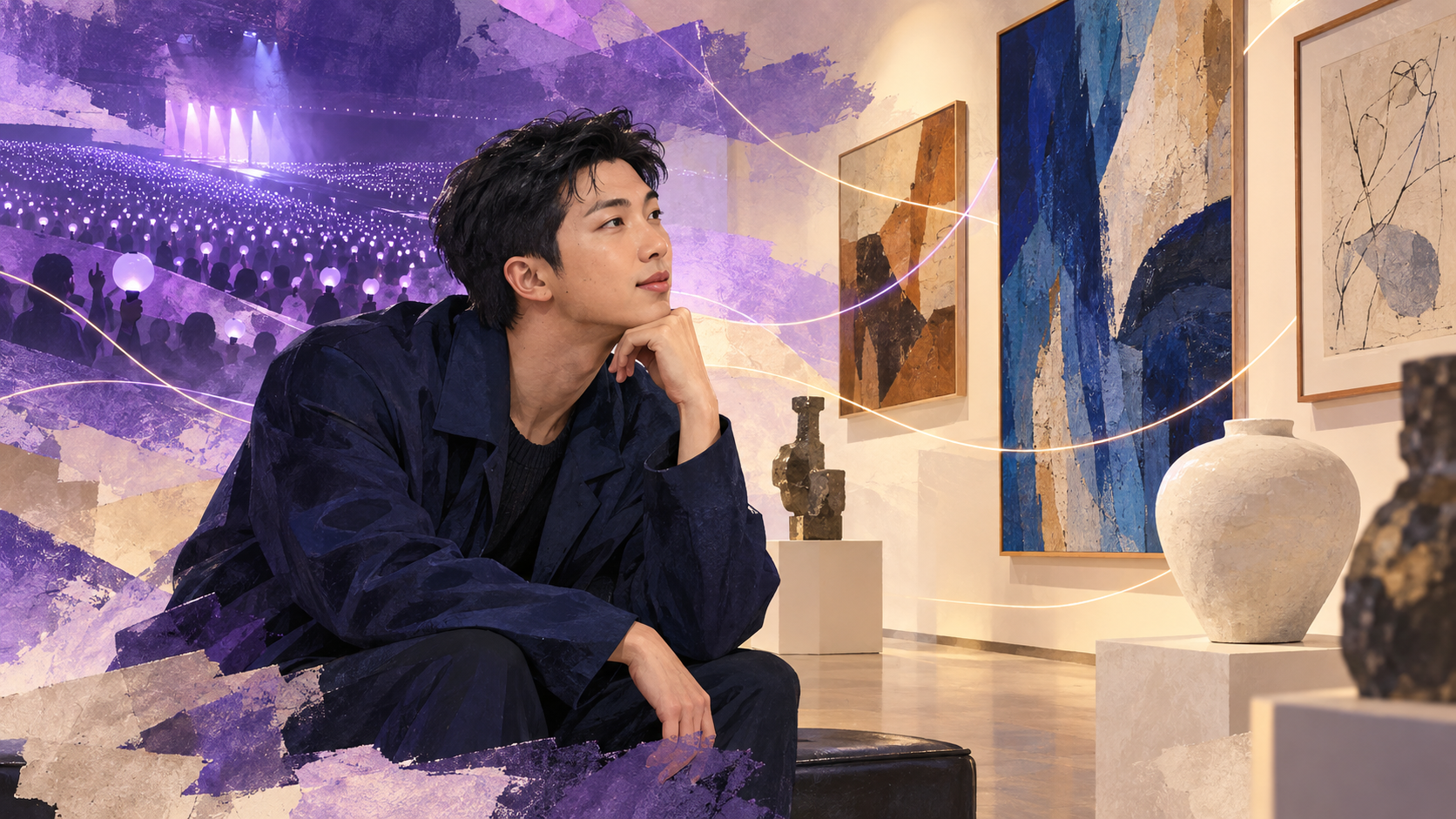
Both images are AI-generated illustrations. The main image is an artistic depiction inspired by RM; its setting and artworks are imagined. It is not a photograph or a reconstruction of the actual SFMOMA exhibition or its artworks.
This is an English adaptation of 좋아하는 작품을 고르는 것도 창작일까?, published by iD News.
SOURCES
- SFMOMA — RM x SFMOMA: Between You and Me. Official exhibition page: dates and works from RM’s collection.
- SFMOMA — Exhibition press release. Updated September 29, 2026: total works, co-curators, and bilingual interpretation.
- SFMOMA — A Private Collection of Korean Art Revealed. Exhibition themes and specific artwork pairings.
- Mission Local — Between You and Me opens at SFMOMA. October 2, 2026: local reporting from the exhibition preview.